
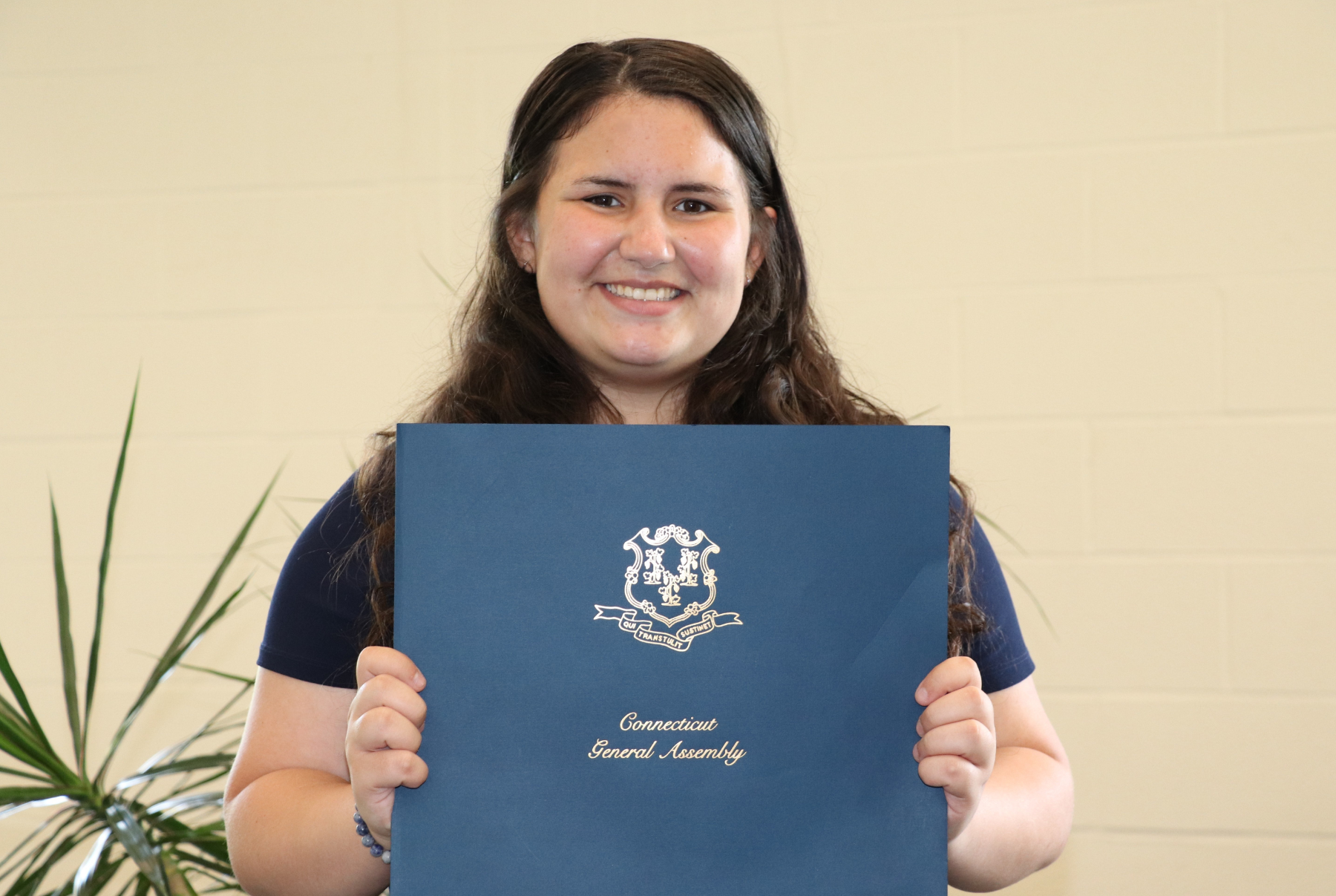
From the moment she began her first year at Mitchell College, senior Rachel Casasnovas set her sight on obtaining two internships: one to support her major in psychology and one for her minor in history and government.
“I have always been stuck between my two interests and figured I would need two internships to explore them more,” she said.
Happily, she found a single internship to suit all her interests. She worked as legislative intern with the Connecticut General Assembly for the Spring 2026 semester.
Waited for the Right Time
“I first learned about the Connecticut General Assembly Legislative Internship Program as a freshman in a government course I took with Dr. Jeff O’Leary. He said the program was available to upperclassmen, so when the time was right, I pursued it.”
Rachel met several times with Paul Dunn in the Integrative Career Services office. She noted that he played an integral role in helping her prepare her application for the competitive internship.
“Paul supported me throughout the process. He helped me with my resume, practicing interview skills, and completing paperwork. He was a big contributor to me securing my internship.”
Internship Placement Played to Interests
Rachel worked with State Sen. MD Rahman of Connecticut’s 4th District.
“The placement with Sen. Rahman aligned well with my interests. He serves on the public health and judiciary committees, which affiliate with my major and minor. I worked two days each week, and my assignments changed every day. Sometimes I attended public hearings and took notes. Sometimes I sat in on Senate sessions to observe and listen. Other times I checked Connecticut news sources to find out what was being reported. I also wrote emails to constituents.”
Put Skills Learned in Classroom to Work
Grateful for the preparation she received at Mitchell, Rachel found herself drawing on the college’s Mitchell Ability Model often.
“I used critical thinking the most in my job. In my day-to-day interactions with people, I had to be aware of not sharing information outside of the caucus. I also thought about how I wrote email responses to constituents, not promising something on behalf of the senator. I also applied the social responsibility skill to my job. We wanted to make sure that constituent concerns and voices were heard and addressed.”
She credits the culture of support on the Mitchell campus, in tandem with the Abilities Model, for giving her the confidence to talk to people, an essential skill when working in government.
“I talked with many people in my internship, from my fellow interns to legislators to constituents, and used to be afraid to do that. Mitchell helped pull me out of my shell, and I’m so grateful for that. Now I talk constantly. The Mitchell Ability Model focuses on seven skillsets — 7 Essential Abilities — weaving them through the curriculum so that every student develops these broad competencies, whatever their area of study. One or more of the abilities is embedded into each course to provide a practical approach to mastering relevant skills, skills that I will use in any career and in my daily life.”
Serving Community
Her campus involvement includes a part-time library job, leadership roles in the Student Government Association and Behavioral Science club, and work as a Resident Assistant with the Thames at Mitchell College Program. She also participates in the Honors Program.
Looking ahead to careers after college, Rachel found her internship a useful tool for exploring more possibilities than she imagined.
“Now I know that being in government isn’t just being a politician and includes a lot of constituent work that isn’t publicized. It’s still doing good work for people and making sure everyone is being represented. The legislators and behind-the-scenes staff really care about what they are doing. They all want to help their communities and make sure processes are followed and deadlines are hit.”
A Future of Possibilities
Rachel also gained clarity on bringing her two interests together in the future.
“When I started at Mitchell as an undergraduate, my plan was to ultimately pursue a Master of Social Work to be social worker. After working in my internship, I see that I can truly combine my interests in psychology and government, perhaps working as an aide on the public health committee, for example. I do hope to find myself back at the Connecticut General Assembly in the future, either to testify on behalf of my job or to work there in some capacity.”
Reflecting more on her experience, she said, “I am incredibly grateful that Mitchell helped make it possible.”
