
Jaileen Barber ’26 landed in the right spot when she transferred as a sophomore to Mitchell College from a large university.
“I went to a huge school, and it affected my academics and my social life. My classes were so large that no one noticed if I skipped, and I didn’t like campus living so I came home every weekend,” she said.
“I live locally and wanted to commute. I also needed smaller classes. The size of Mitchell and the distance to my house were so appealing. It was the only school where I applied to transfer,” she said.
On the Mitchell campus Jaileen found her passion, challenge, and opportunity. (She also earned the highest GPA of her graduating class, making her valedictorian of the Class of 2026.)
“I transferred to Mitchell as a psychology major with a minor in criminal justice. By the end of my sophomore year, I finished the required courses for my minor and was upset about it. The criminal justice classes piqued my interest. After meeting with my advisor about flip-flopping my major and minor, I chose to make the shift. My criminal justice professors jokingly said they moved me to the dark side, but they saw something in me that made me a strong student in the major.”
Classwork Leads to Honors Program
Criminal justice professor Dr. Tim Daty also recognized her writing ability and recommended her for the Mitchell College Honors Program.
The honors program prepares students for graduate school and beyond. It provides them with the foundational knowledge and skills needed to research and write an honors thesis and ultimately defend it in their senior year.
“I needed an extra challenge,” she said. “I wanted to keep my brain constantly moving. The honors program helped push me to do more, which was needed. I can be a procrastinator and sometimes don’t have much faith in myself.”
The inspiration for Jaileen’s thesis, “Politics and Policy Implementation of Firearms on Firearm Suicide,” came from her off-campus workplace.
“I work as an administrative assistant at Brian’s Healing Hearts, a nonprofit that provides grief support to people who have lost loved ones and focuses on mental health and suicide awareness. The foundation was created in honor of the founders’ 19-year-old son, who they lost to suicide. I find myself doing research on suicide daily. It’s a key interest of mine to further develop knowledge on it.”
Jaileen had already written research papers on suicide in males, who dominate the statistic. For her thesis, she decided to dive deeper into firearm usage, the most lethal means and the main method utilized by men.
She said the honors program also gave her a chance to research something tied to a potential career.
Training for the Future
“In the fall I start a Master of Social Work program. I have always wanted to work with adolescent males and researching my thesis topic gave some insight that I might not have had at this point.”
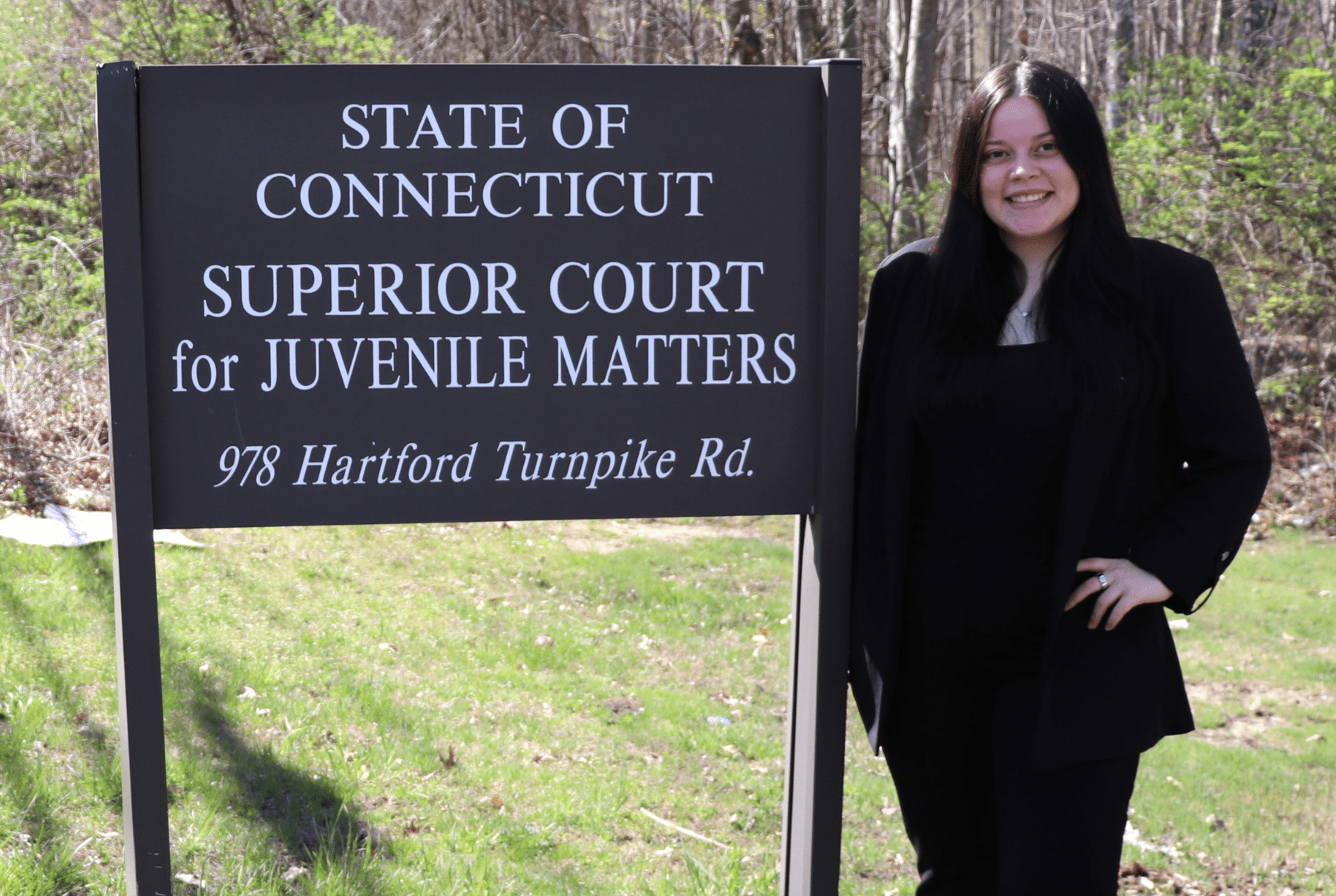
Her internship at Waterford Juvenile Probation through the State of CT Judicial Experiential Learning program also provided Jaileen with an opportunity to imagine her future. She completed the internship in her final semester and credits Paul Dunn, Mitchell’s Integrative Career Development coordinator, with helping her get her foot in the door by reaching out to his contacts in the program.
“Before working with juvenile probation, I had never considered a career in it. But I was impressed that it takes a therapeutic approach to working with youth. I enjoy the therapy realm and aspire to make it my life’s work. My internship shifted my mindset on what I want to do.”
Jaileen appreciated the work environment at juvenile probation.
“I genuinely felt like a peer when I walked in, not just an intern. The level of trust that was placed in me gave me so much confidence. Something new was always thrown at me when I stepped in the door.”
Her daily internship tasks varied; Fridays were a typical court day, and other days were spent doing things such as school visits and intakes. She saw parallels to cases she studied in a juvenile delinquency course and expanded her understanding as the concepts came to life.
“In person, the stories made sense. I saw kids’ everyday lives and learned what worked best for each situation. There was a lot of thinking and revision, constant movement, and a lot of case notes and reports.”
Her biggest challenge was learning the acronyms that were heavily incorporated into notes and reports.
“There were so many to learn that it was hard to keep up. Luckily, cheat sheets were posted in every office, so I could figure things out!”
Shifting Mindset, Opening Doors
Reflecting on new career possibilities, Jaileen said, “Mitchell offered me the freedom to explore interests I never thought about for my future. I always assumed that if I’m going for my MSW, the only right answer was to major in psychology. Switching my major allowed me to explore an internship I had no idea would interest me as a career. Interning with juvenile probation opened my eyes to different paths that fit what I want to do. Meeting professors with real-world experience shifted my mindset and opened many more doors. Their positive mentorship and constant reassurance encouraged me to show off my academic potential and gave me the strength I needed to continue to push myself forward.”
