
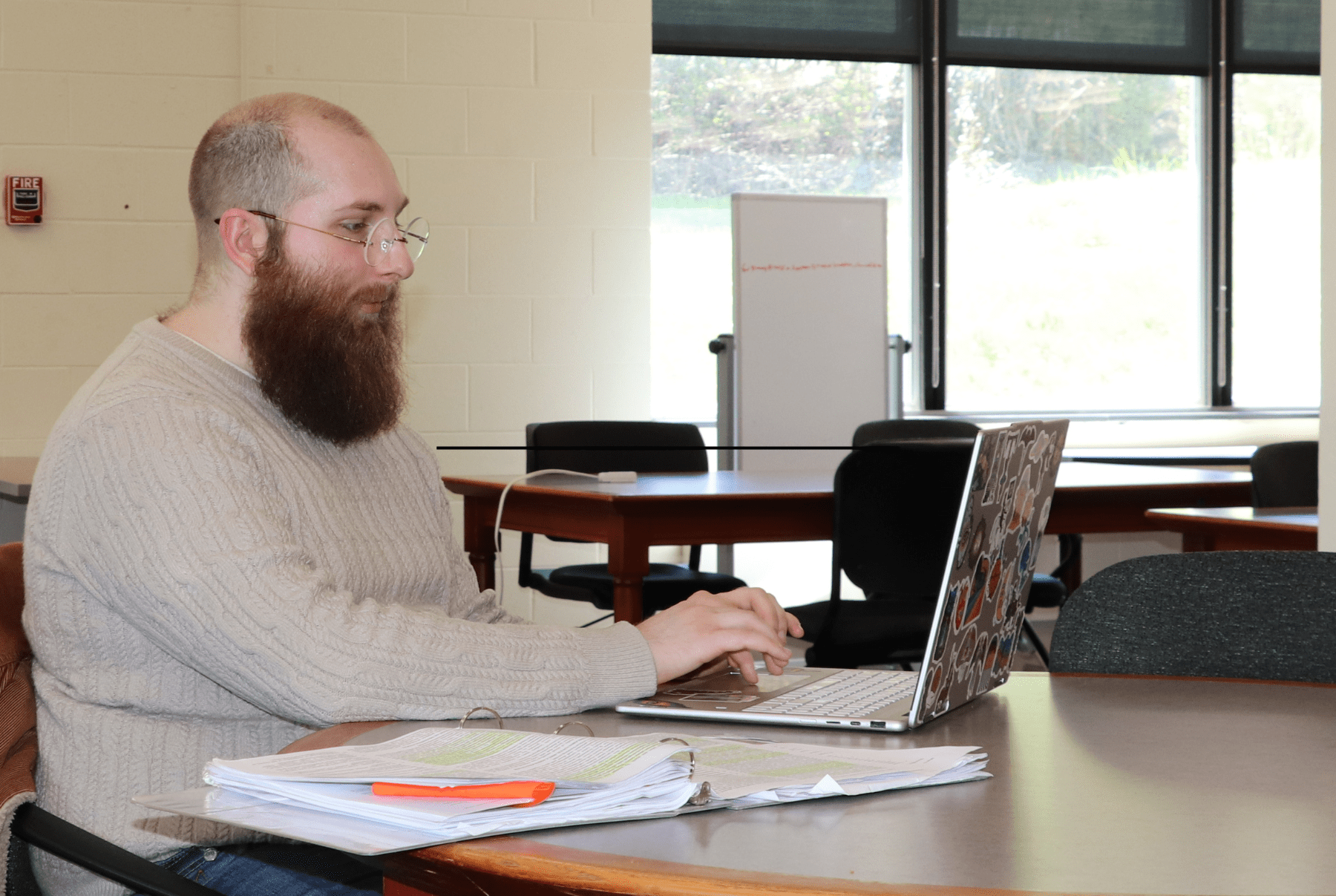
“Compassion,” “community,” and “personal” are three words senior Matthew Dougherty uses to describe Mitchell College. He carries the same three qualities into his internship helping people in crisis.
An Honors Program student majoring in psychology with a minor in sociology, he said, “You get a lot of compassion from the faculty and staff at Mitchell. It is a college that offers a lot of support. Before I began at Mitchell, I was in a rough place with my mental health. I didn’t think I would be able to do college. But I got the academic and emotional support that I needed to get through the first couple years. Mitchell was the right choice for me.”
“Community also stands out to me when thinking about Mitchell. Most students know each other on the close-knit campus. And every student that I know has had a unique and personal experience. They have gotten the support they needed and found opportunities tailored just for them.”
Opportunity for real-world work
An important opportunity for Matthew is his internship as a volunteer crisis counselor with the Crisis Text Line, a remote company that is partnered with 988, the national suicide prevention hotline. People in crisis can text 988 to reach the Crisis Text Line any time of day for support.
Matthew is logging 200 hours for his internship with the organization. He can work using his laptop from anywhere, for any number of hours at a time.
“There are no set hours, so I can log in and do a few hours here and there, but I like to do the night shift from 11 p.m. to 7 a.m. There aren’t a lot of people to help at that time, and it is usually high volume. There’s text after text. This is exactly what I want to do with my psychology studies. I want to help people in crisis and help them out of a dark moment. My internship is giving me direct experience with this, as I talk them through it and am trained to get emergency life services if they need it. It is intense stuff.”
Matthew’s required preparation for this role included 15 hours of training via a combination of psychoeducation text modules, complementary videos, and simulated conversations. He was also trained to screen for immediate safety.
“We ask a person if they have harmed themselves or thought about suicide. If the answer is yes, we flag a supervisor to watch the chat and advise on responses. I was also trained on how do develop a safety plan with people and what things to look out for, such as any kind of abuse with a vulnerable population.”
Self-care important
When applying for the position, Matthew provided his background information and hours of availability. He was also asked to share how he takes care of his mental health and any topics he would be uncomfortable dealing with.
“The work is more intense than I thought it would be. I try to get two eight-hour shifts in per week but am considering breaking it into smaller chunks.”
Matthew said once he finishes a conversation with a texter he can take as much time as he needs to do self-care. He likes to watch something, have a snack, or talk with a friend.
“Many of the texts are so intense, but some are more light-hearted. You never know what you’re going to get, just like life.”
He said he was trained to deal with callers in a specific way: acknowledge, validate, listen, and offer resources. His classes in abnormal psychology and counseling theory have helped prepare him for this real-world work.
“If a person is going through mania or psychosis or displaying symptoms of an eating disorder or are in an abusive situation, these are all things that I have learned about in class.”
Similarly, he finds his grounding in the Mitchell Abilities helpful with his work—from using a data collection platform on a computer to deescalating a situation and figuring out a situation to meeting people of all backgrounds and cultures where they are.
“My skills in technology, problem solving, communication, critical thinking, and ethics have all been put to use,” he said.
Being a ‘voice and shoulder’
Matthew said he feels most challenged the moment before he begins his shift.
“There’s uncertainty. I care deeply about the people I interact with. It’s the hardest part but the most rewarding. I want to work in the field professionally, helping people directly, and what I am learning through my internship is something that can’t be taught in a classroom. Getting to be there with people in the middle of a crisis, to be the voice and shoulder, to help them out of that, there’s nothing better than that.”
Matthew is grateful for the requirement that every student at Mitchell College does an internship before they graduate. He considers it another highlight of the Mitchell experience.
“I wanted to go to a college that made me go out and get an internship because I can be a bit lazy and need that push. That is why Mitchell was a good fit. My one-on-one interaction with my professors has helped me so much. With their help and guidance, I feel secure in my future with my sights on getting a master’s degree and beyond. I wouldn’t have gotten that at a big college.”
